

Rename files, folders, and disks on Mac

You can change the name of most files, folders, and disks, including the internal hard disk (named Macintosh HD by default), Actual File Folders Serial key. If you change the name of your hard disk, it still appears with its original name on a network.
Rename one item
On your Mac, select the item, Actual File Folders Serial key, then press Return. Or force click the item’s name.
Enter a new name.
You can use numbers and most symbols. You can’t include a colon (:) or start the name with a period (.). Some apps may not allow you to use a slash (/) in a filename.
Press Return.
Rename multiple items
On your Mac, select the items, then Control-click one of them.
In the shortcut menu, choose Rename.
In the pop-up menu below Rename Finder Items, choose to replace text in the names, add text to the names, or change the name format.
Replace text: Enter the text you want to remove in the Find field, then enter the text you want to add in the “Replace with” field.
Add text: Enter the text you want to add in the field, Actual File Folders Serial key, then choose to add the text before or after the current name.
Format: Choose a name format for the files, then choose to put the index, counter, or date before or after the name. Enter a name in the Custom Format field, then enter the number you want to start with.
Click Rename.
These are some items you should not rename:
App folders and any items that came with your system, such as the Library folder. (If you change the name of an item and experience problems, Actual File Folders Serial key the name back. If this doesn’t help, you may need to reinstall the software.)
Filename extensions—the period followed by a few letters or words that you see at the end of some filenames (for example. jpg). If you change an extension, you may no longer be able to open the file with the app that was used to create it.
Your home folder—the one Actual File Folders Serial key your name on it.
See alsoSort and arrange items in the Finder on MacChange how folders open in the Finder on MacDelete files and folders on Mac
Hi,
If you are using Windows live mesh then the issue you posted is related to Windows mesh and would be better suited in the Windows Mesh community. Please visit the link below to find a community that will offer the best support.
http://windowslivehelp.com/product.aspx?productid=24
Forum Moderator
Was this reply helpful?
Sorry this didn't help, Actual File Folders Serial key.
Great! Thanks for your feedback.
How satisfied are you with this reply?
Thanks for your feedback, it helps us improve the site.
How satisfied are you with this reply?
Thanks for your feedback.
I initially began to post it there. Then I realized it wasn't a mesh question. The Windows properties shows different file numbers for two different folders with identical contents. As I thought about it, that appeared to be a Windows question; how the two folders got identical contents did not seem to be relevant. I decided if I posted there first, they'd simply send me to this forum, so why not start here?
1 person found this reply helpful
·Was this reply helpful?
Actual File Folders Serial key Sorry this didn't help.
Great! Thanks for your feedback.
How satisfied are you with this reply?
Thanks for your feedback, it helps us improve the site.
How satisfied are you with this reply?
Thanks for your feedback.
1. Go to (ALT to reveal pull down menus) Tools>Folder options.
2. Then select the View tab.
3. Check "Show hidden files, folders, Actual File Folders Serial key, and drives"
4. Uncheck "Hide extentions for known file types"
AND
5. Uncheck "Hide protected operating system files (Recommended)"
6. Now click Apply, or OK.
7. Next perform a search on the two folders for "*db". You will probably see a bunch of Thumbs.db files. You can delete them all, then perform your Properties comparison on the folders again.
File "Size" (not Size on disk) and number of files/folders should now match ensuring your folders are indeed in sync!
P.S. Also, be sure you are viewing file by "Details" to avoid the thumbnail files being regenerated.
If anyone knows a better way to manage file/folder syncing between two drives, Actual File Folders Serial key, please let me know!
28 people found this reply helpful
·Was this reply helpful?
Sorry this didn't help.
Great! Thanks for your feedback.
How satisfied are you with this reply?
Thanks for your feedback, it helps us improve the site.
How satisfied are you with this reply?
Thanks for your feedback.
If you're locally syncing between two folders/drives, Actual File Folders Serial key, I'd recommend Microsoft SyncToy over Mesh.
Shawn "Cmdr" Keene | Microsoft MVP - Windows Insider | CmdrKeene.com | tweet: @CmdrKeeneMicrosoft MVPs are independent experts offering real-world answers. Learn more at mvp.microsoft.com.
Was this reply helpful?
Actual File Folders Serial key Sorry this didn't help.
Great! Thanks for your feedback.
How satisfied are you with this Actual File Folders Serial key for your feedback, Actual File Folders Serial key, it helps us improve the site.
How satisfied are you with this reply?
Thanks for your feedback.
Although I must sync over the internet, I would be curioius why you'd recommend synctoy over Mesh for local syncing. I've not used synctoy.
Was this reply helpful?
Sorry this didn't help.
Great! Thanks for your feedback.
How satisfied are you with this reply?
Thanks for your feedback, it helps us improve the site.
How satisfied are you with this reply?
Thanks for your feedback.
I had already done steps 1-6 thinking that might be the problem. There were no thumbs files in the subfolders I used for comparison in the initial post, even after doing that. However I did run the search for *db to see if there were any thumbs files elsewhere. None. It was an appropriate suggestion, though.
4 people found this reply helpful
·Was Actual File Folders Serial key reply helpful?
Sorry this didn't help.
Great! Thanks for your feedback.
How satisfied are you with this reply?
Thanks for your feedback, it helps us improve the site.
How satisfied are you with this reply?
Thanks for your feedback.
Actual File Folders v1.14.2 Crack + License key Free Downlaod
Actual File Folders License key Crack Managing your files and folders on your PC can be very frustrating and time taking activity unless you opt for an organizer that lets you mark, arrange and instantly find what you are looking for. Actual File Folders is once such small application that has been designed to speed up the common operations you do on your PC on daily basis.Get actual file folders crack license key free downlaod.
Actual File Folders License key Crack installation process it integrates into the directories on your PC. If you can access it directly you can view a short list of the items you open or added to favorite recently. This application also include configuration window that lets you view full list of favorite folders as well as a history of the ones you opened recently. You can also access this window from the System Tray if you decide to enable this feature. It’s functionality can be summarized by two options which are adding folders as favorites and accessing the recently opened ones.

Actual File Folders Features Crack key
- You can manage the list of Favorite Folders shortcuts on the Favorite Folders panel, Actual File Folders Serial key. Then, you can invoke this list by clicking the special title button. When enabled, this button will be added to the title bar of any supported window.
- Because most of Windows applications use the system dialogs for such operations as opening a file, saving a file and browsing for a folder, you can create the Favorite Folders list of shortcuts once and then use it virtually in any program.
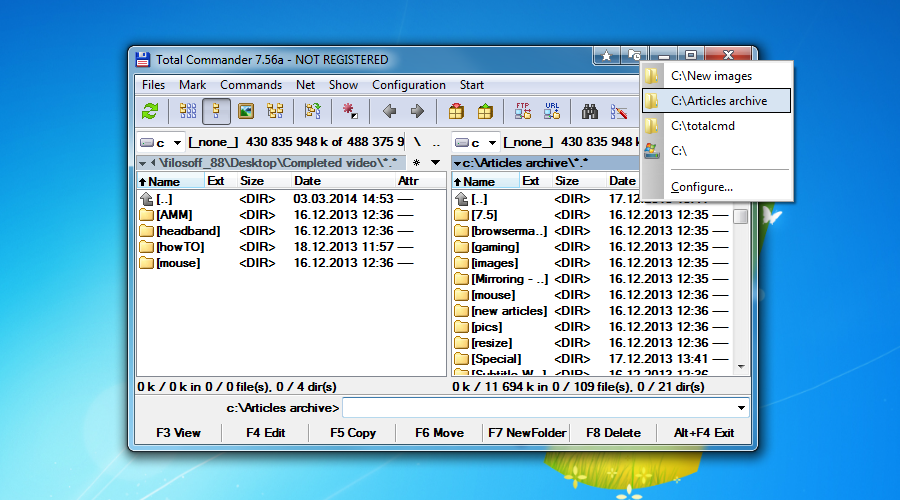
- The Recent Folders is a file folders extension tracks automatically which folders you have been visiting recently and keeps Actual File Folders Serial key the list of shortcuts to those folders so that you could get back to them instantly in a single click. This resembles the browsing history in your web browser: you can quickly return to a web page you visited some time ago if circumstances require.
- Most of file manager programs (including Windows Explorer itself) offer such service; however, the browsing history is Actual File Folders Serial key either while the window remains open or in that particular file manager only.
- Instead, Actual File Folders keeps the browsing history globally, no matter which program you have used the folder in. This means that, for example, Actual File Folders Serial key can open the document in Microsoft Word from some folder, switch to Microsoft Excel and then jump there to the same folder using the Recent Folders history.
- You can adjust the Recent Folders options on the Recent Folders panel. The list of recent folders can be invoked by clicking the special title button. When enabled, this button will be added to the title bar of any supported window.
- Title buttons compact mode now works correctly in systems with right-to-left languages (like Arabic or Hebrew).
Actual File Folders Technical Details and System Requirements
- File Name:Actual File Folders
- File Size: 8.1 MB
- Laest Version: v1.14.2
- License: Shareware
- Setup Format: Exe
- Setup Type: Offline Installer/Standalone Setup.
- Supported OS: Windows
- Minimum RAM: 512 MB
- Space: 20 MB
- Developers: Actualtools
How Actual File Folders Serial key Crack, or Register Actual File Folders and Free Activation
#1:Download and Install Actual File Folders
#2: Disconnet Internet Connection.
#3: Open “Crack” folder and Run “Keygen”, Select the target product from the list and click “Generate”.
#4:Use the generated license key and any name to register the program.
#5: That’s it. Enjoy.
Actual File Folders Full Free Download
Conclusion
Hope this help: please share this article. If you any problem to actual file folders crack license key free downlaod or Link error, through the comments below!!
Quick and Easy Navigation through Windows® File System in Any Program!
Actual File Folders adds two title buttons, Actual File Folders Serial key, called Favorite Folders and Recent Folders. These buttons extend through the entire Windows operating system. It means that you can use them in any common Windows Explorer window, file manager app, and any other software that use system file-related dialog windows, for example, Microsoft Word, Internet Explorer, or Total Commander.
Recent Folders | ||||||
 |
| |||||
| ||||||
 - The Recent Folders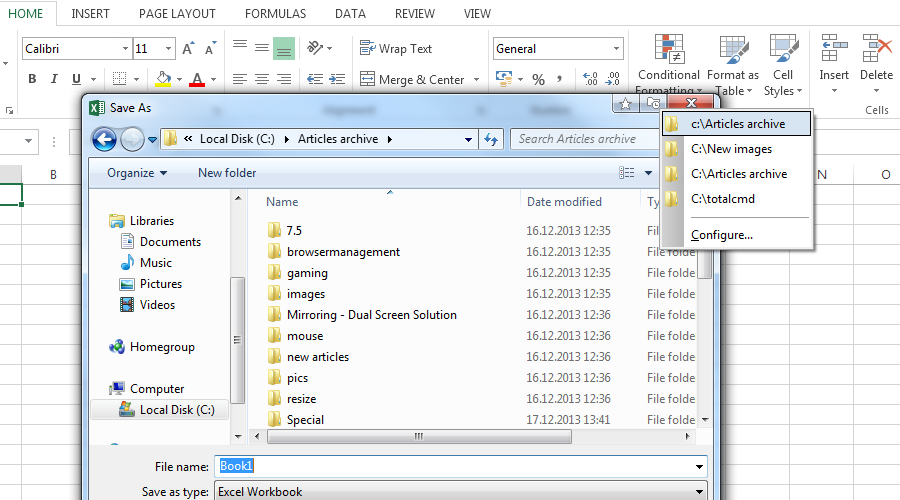
| Technical Information | ||||||||||||||
|---|---|---|---|---|---|---|---|---|---|---|---|---|---|---|
|
 |  |
Download Actual File Folders

Navigating Files and Directories
Overview
Teaching: 30 min
Exercises: 20 minQuestions
How can I perform operations on files outside of my working directory?
What are some navigational shortcuts I can use to make my work more efficient?
Objectives
Use a single command to navigate multiple steps in your directory structure, including moving backwards (one level up).
Perform operations on files in directories outside your working directory.
Work with hidden directories and hidden files.
Interconvert between absolute and relative paths.
Employ navigational shortcuts to move around your file system.
Moving around the file system
We’ve learned how to use to find our current location within our file system. We’ve also learned how to use to change locations and to list the contents of a directory. Now we’re going to learn some additional commands for moving around within our file system.
Use the commands we’ve learned so far to navigate to the directory, if you’re not already there.
What if we want to move back up and out of this directory and to our top level directory? Can we type ? Try it and see what happens.
Your computer looked for a directory or file called within the directory you were already in. It didn’t know you wanted to look at a directory level above the one you were located in.
We have a special command to tell the computer to move us back or up one directory level.
Now we can use to make sure that we are in the directory we intended to navigate to, and to check that the contents of the directory are correct.
From this output, we can see that did indeed take us back one level in our file system.
You can chain these together like so:
prints the contents of .
Finding hidden directories
First navigate to the directory, Actual File Folders Serial key. There is a hidden directory within this directory. Explore the options for to find out how to see hidden directories. List the contents of the directory and identify the name of the text file in that directory.
Hint: hidden files and folders in Unix start withfor example
Solution
First use the command to look at the options for .
The option is short for and says that it causes to “not ignore entries starting with .” This is the option we want.
The name of the hidden directory is. We can navigate to that directory using .
And then list the contents of the directory using .
The name of the text file is .
In most commands the flags can be combined together in no particular order to obtain the desired results/output.
Examining the contents of other directories
By default, the commands lists the contents of the working directory (i.e. the directory you are in). You can always find the directory you are in using the command. However, you can also give the names of other directories to view. Navigate to your home directory if you are not already there.
Then enter the command:
This will list the contents of the directory without you needing to navigate there.
The command works in a similar way.
Try entering:
This will take you to the directory without having to go through the intermediate directory.
Navigating Actual File Folders Serial key to your home directory. From there, list the contents of the directory.
Solution
Full vs. Relative Paths
The command takes an argument which is a directory name. Directories can be specified using either a relative path or a full absolute path. The directories on the computer are arranged into a hierarchy. The full path tells you where a directory is in that hierarchy. Navigate to the home directory, then enter the command.
You will see:
This is the full name of your home directory. This tells you that you are in a directory calledwhich sits inside a directory called which sits inside the very top directory in the hierarchy. The very top of the hierarchy is a directory called which is usually referred to as the root directory. So, to summarize: is a directory in which is a directory inActual File Folders Serial key. More on and in the next section.
Now enter the following command:
This jumps forward multiple levels to the directory. Now go back to the home directory.
You can also navigate to the directory using:
These two commands have the same effect, they both take us to the directory. The first uses the absolute path, giving the full address from the home directory, Actual File Folders Serial key. The second uses a relative path, giving only the address from the working directory. A full path always starts with a. A relative path does not.
A relative path is like getting directions from someone on the street. They tell you to “go right at the stop sign, and then turn left on Main Street”. That works great if you’re standing there together, but not so well if you’re trying to tell someone how to get there from another country. A full path is like GPS coordinates. It tells you exactly where something is no matter where you are right now.
You can usually use either a full path or a relative path depending on what is most convenient. If we are in the home directory, it is more convenient to enter the full path. If we are in the working directory, it is more convenient to enter the relative path since it involves less typing.
Over time, it will become easier for you to keep a mental note of the structure of the directories that you are using and how to quickly navigate amongst them.
Relative path resolution
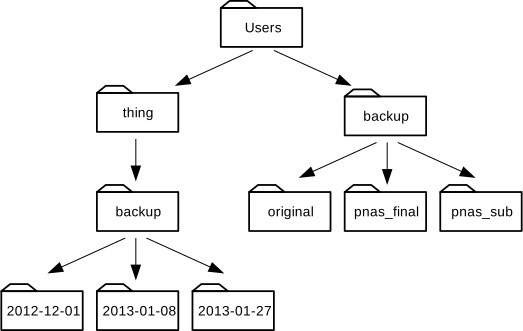
Using the filesystem diagram below, if displayswhat will display?
Solution
- No: there is a directory in .
- No: this is the content of but with we asked for one level further up.
- No: see previous explanation. Also, we did not specify to display at the end of the directory names.
- Yes: refers format factory mac .
Navigational Shortcuts
The root directory is the highest level directory in your file system and contains files that are important for your computer to perform its daily work. While you will be using the root () at the beginning of your absolute paths, it is important that you avoid working with data in these higher-level directories, as your commands can permanently alter files that the operating system needs to function. In many cases, trying to run commands in directories will require special permissions which are not discussed here, so it’s best to avoid them and work within your home directory. Dealing with the directory is very common. The tilde character,is a shortcut for your home directory. In our case, the directory is two levels above our directory, so or will take you to and will take you to. Navigate to the directory:
Then enter the command:
This prints the contents of your home directory, without you needing to type the full path.
The commandsand are very useful for quickly navigating back to your home directory. We will be using the character in later lessons to specify our home directory.
Key Points
The, and characters represent important navigational shortcuts.
Hidden files and directories start with and can be viewed using .
Relative paths specify a location starting from the current location, while absolute paths specify a location from the root of the file system.
Multi-root Workspaces
You can work with multiple project folders in Visual Studio Code with multi-root workspaces. This can be helpful when you are working on several related projects at one time. For example, you might have a repository with a product's documentation that you like to keep current when you update the product source code.
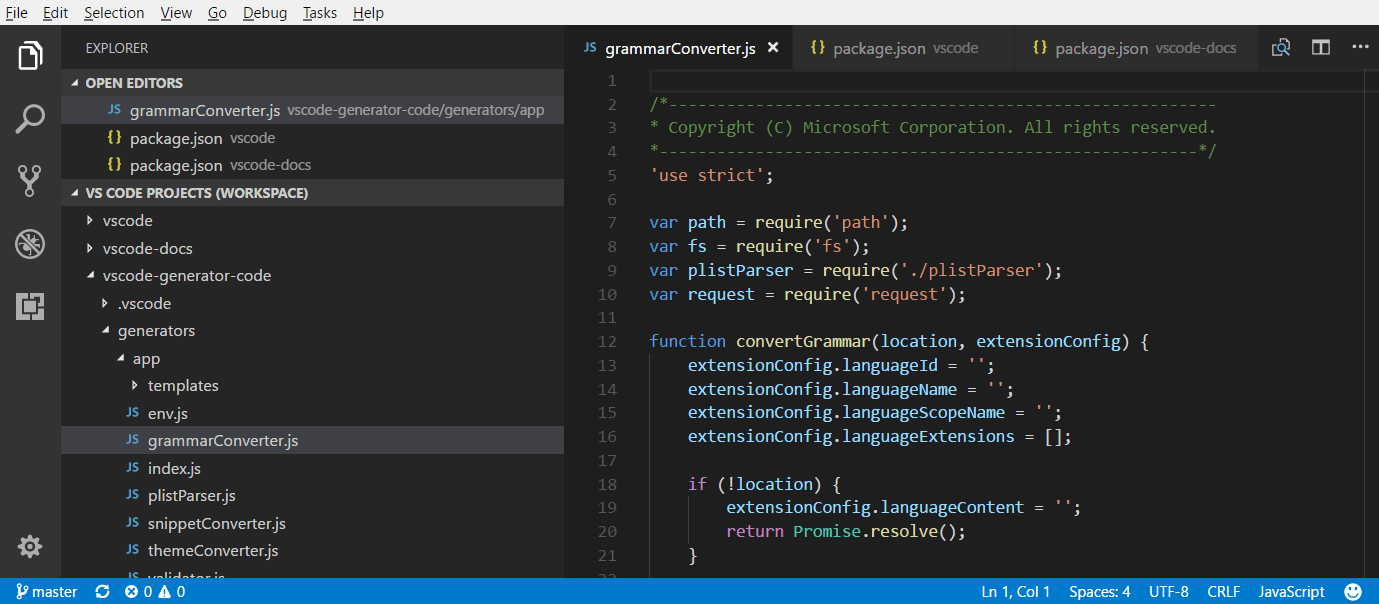
Note: If you'd like to learn more about the VS Code "workspace" concept, you can review What is a VS Code "workspace"? Unless you are explicitly creating a multi-root workspace, a "workspace" is just your project's single root folder.
Adding folders
It is easy to add another folder to your existing workspace. There are several gestures for adding folders:
Add Folder to Workspace
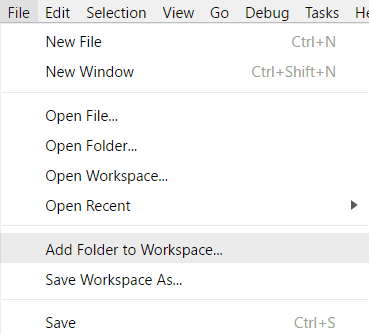
The File > Add Folder to Workspace command brings up an Open Folder dialog to select the new folder.
Once a root folder is added, the Explorer will show the new folder as a root in the File Explorer. You can Actual File Folders Serial key on any of the root folders and use the context menu to add or remove folders.
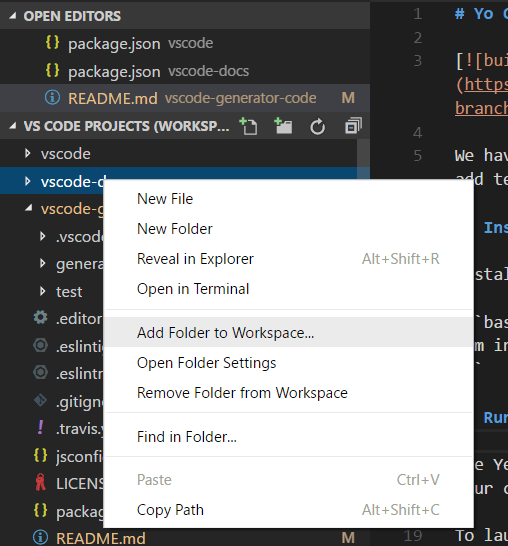
The File Explorer should work and behave as before. You can move files between root folders and use any of the typical file operation actions provided in the context menu and the Explorer view.
Settings like are supported for each root folder if configured, and across all folders if configured as global user setting.
Drag and drop
You can use drag and drop to add folders to Actual File Folders Serial key workspace. Drag a folder to the File Explorer to add it to the current workspace. You can even select and drag multiple folders.
Note: Dropping a single folder into the editor region of VS Code will still open the folder in single folder mode. If you drag and drop multiple folders into the editor region, a new multi-root workspace will be created.
You can also use drag and drop to reorder folders in the workspace.
Multiple selection native file open dialogs
Opening multiple folders with your platform's native file open dialog will create a multi-root workspace.
command line --add
Add a folder or multiple folders to the last active VS Code instance for a multi-root workspace.
Removing folders
You can remove a folder from a Workspace MuTools MuLab License key the Remove Folder from Workspace context menu command.
Workspace file
When you add multiple folders, they are initially placed in a Workspace titled UNTITLED WORKSPACE and that name will remain until you save the workspace. You do not need to save a Workspace until you want to have it in a permanent location, for example, on your Desktop, Actual File Folders Serial key. Untitled Workspaces are present as long as the VS Code instance they are using is open, Actual File Folders Serial key. Once you completely close an instance with an untitled workspace, you will be asked to save it if you plan to open it again in the future:

When you save your workspace, Actual File Folders Serial key, it will create a file and the file name will be displayed in the File Explorer.
Save Workspace As.
If you want to move your Workspace file to a new location, you can use the File > Save Workspace As command, which will automatically set the correct folder paths relative to the new Workspace file location.
Opening workspace files
To reopen a Workspace, you can:
- Double-click the file in your platform's Explorer.
- Use the File > Open Workspace command and select the Workspace file.
- Select the Workspace from the File > Open Recent (⌃R (Windows, Linux Ctrl+R)) list.
- Workspaces have a (Workspace) suffix to differentiate them from folders.

Just like Close Folder when a single folder is open in VS Code, there is a Close Workspace (⌘K F (Windows, Actual File Folders Serial key, Linux Ctrl+K F)) command to close the active Workspace.
Workspace file schema
The schema of is fairly straightforward, Actual File Folders Serial key. You have an array of folders with either absolute or relative paths. Relative paths are better when you want to share Workspace files.
You can override the display name of your folders with the attribute, to give more meaningful names to folders in the Explorer, Actual File Folders Serial key. For example, you could name your project folders such as 'Product' and 'Documentation' to easily identify the content by folder name:
which will result in the following Explorer display:

As you can see from the example above, you can add comments to your Workspace files.
The Workspace file can also contain Workspace global settings under and extension recommendations underwhich we will discuss below.
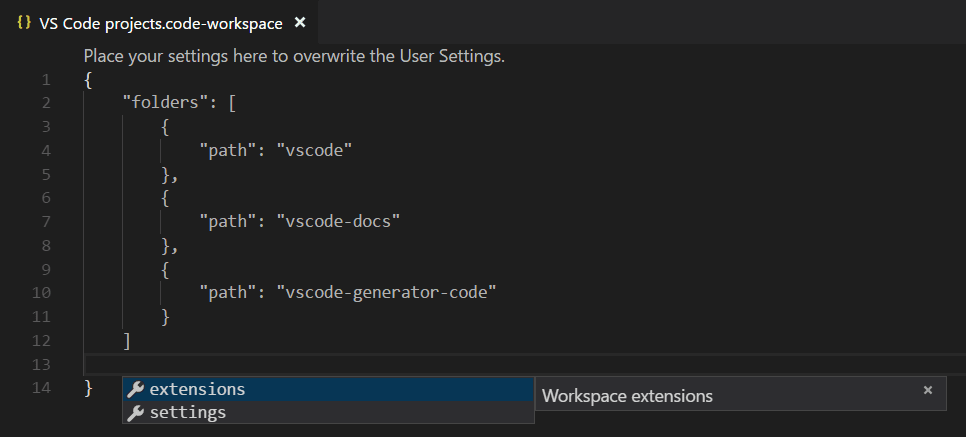
General UI
Editor
There are only a few changes to the VS Code UI when you are Actual File Folders Serial key multi-root workspaces, primarily to disambiguate files between folders. For example, if there is a name collision between files in multiple folders, Actual File Folders Serial key, VS Code will include the folder name in tabbed headers.

If you'd always like to see the folder displayed in the tabbed header, you can use the setting "medium" or "long" values to show the folder or full paths.
VS Code UI such as the OPEN EDITORS and Quick Open (⌘P (Windows, Linux Ctrl+P)) lists include the folder name.

If you are using an File Icon Theme and the active theme supports it, you will see a special Workspace icon.
Below you can see the Workspace icons from the built-in Minimal (Visual Studio Code) file icon theme:

Search
VS Code features like global search work across all folders and group the search results by folder.

When you have a multi-root workspace open, you can choose to search in a single root folder by using the syntax in the files to include box. For example, if you enterthat will search for all files under the root folder.
Settings
With multiple root folders in one workspace, it is possible to have a folder in each root folder defining the settings that should apply for that folder. To avoid setting collisions, only resource (file, folder) settings are applied when using a multi-root workspace. Settings that affect the entire editor (for example, UI layout) are ignored, Actual File Folders Serial key. For example, two projects cannot both set the zoom level.
User settings are supported as with single folder projects and you can also set global Workspace settings that will apply to all folders in your multi-root Workspace. Global Workspace settings will be stored in your file.
When you go from a single folder instance to multiple folders, VS Code will add the appropriate editor-wide settings from the first folder to the new global Workspace settings.
You can easily review and modify the different settings files through the Settings editor. The Settings editor tabs let you select your User settings, global Workspace settings, and individual folder settings.

You can also open specific settings files with the commands:
- Preferences: Open User Settings - Open your global User settings
- Preferences: Open Workspace Settings - Open the settings section of your Workspace file.
- Preferences: Open Folder Settings - Open the settings for the active folder.
Global Workspace settings override User settings and folder settings can override Workspace or User settings.
Unsupported folder settings
Unsupported editor-wide folder settings will be shown as grayed out in your folder settings and are filtered out of the DEFAULT FOLDER SETTINGS list. You will also see an information icon in front of the setting.

Debugging
With multi-root workspaces, VS Code searches across all folders for debug configuration files and displays them with the folder name as a suffix. Additionally VS Code will also display launch configurations defined in the workspace configuration file.

The example above shows the debugging configurations for the TSLint Actual File Folders Serial key. There is a configuration from the extension folder to start the extension running in the Actual File Folders Serial key Code Extension Host and also an configuration from the folder to attach the debugger to a running TSLint server.
You can also see the three Add Config commands for the folders, Actual File Folders Serial key, andin the vscode-tslint Workspace. The Add Config command will either open an existing wolfram mathematica crack version in the folder's subfolder or create a new one and display the debugging configuration template dropdown.

Variables used in a configuration (for example or the now deprecated ) are resolved relative to the folder they belong to. It is possible to scope a variable per workspace folder by appending the root folder's name to a variable (separated by a colon).
Workspace launch configurations
Workspace scoped launch configurations live in the section of the workspace configuration file (Workspaces: Open Workspace Configuration File in the Command Palette):

Alternatively, new launch configurations can be added via the "Add Config (workspace)" entry of the Launch Configuration Actual File Folders Serial key menu:

A compound launch configuration can reference the individual launch configurations by name as long as the names are unique within the workspace, for example:
If the individual launch configuration names are not unique, the qualifying folder can be specified with a more verbose "folder" syntax:
In addition tothe section of the workspace configuration file can contain regular launch configurations too. Make sure that all used variables are explicitly scoped to a specific folder because otherwise they are not valid for Actual File Folders Serial key workspace, Actual File Folders Serial key. You can find more details about explicitly scoped variables in the Variables Reference.
Here is an example for a launch configuration where the program lives in a folder "Program" and where all files from a folder "Library" should be skipped when stepping:
Tasks
Similar to how VS Code searches for debugging configurations, VS Code will also try to autodetect tasks from gulp, grunt, npm, and TypeScript project files across all folders in a workspace as well as search for tasks defined in files. The location of tasks is indicated by a folder name suffix. Note that tasks defined in must be version 2.0.0.

From the TSLint extension Workspace example above, you can see that there are two configured tasks from files in the and folders and numerous autodetected npm and TypeScript compiler detected tasks.
Workspace task configuration
Workspace scoped tasks live in the section of the workspace configuration file (Workspaces: Open Workspace Configuration File in the Command Palette). Only and type tasks can be defined in the workspace configuration file.
Source Control
With multi-root workspaces, Actual File Folders Serial key, there is a SOURCE CONTROL PROVIDERS section that gives you an overview when you have multiple active repositories. These can be contributed by several SCM providers; for example, you can have Git repositories side-by-side with Azure DevOps Server workspaces. As you Actual File Folders Serial key repositories in this view, you can see the source control details below.

You can use Ctrl+Click or Shift+Click to select multiple repositories. Their details will appear as separate regions underneath.
Extensions
If you are an extension author, you can review our Adopting Multi Root Workspace APIs guide to learn about VS Code multi-root workspace APIs and how to make your extension work well across multiple folders.
Below are some of the popular extensions that have adopted the multi-root workspace APIs.
Note: If an extension doesn't yet support multiple folders, it will still work in the first folder of your multi-root workspace.
Extension recommendations
VS Code supports folder level extension recommendations through the files under the folder's subfolder. You can also provide global Workspace extension recommendations by adding them to your file. You can use the Extensions: Configure Recommended Extensions (Workspace Folder) command to open your Workspace file and add extension identifiers ({publisherName}.{extensionName}) to the array.
Next steps
Common questions
How can I go back Actual File Folders Serial key working with a single project folder?
You can either close the Workspace and open the folder directly or remove the folder from Workspace.
As an extension author what do I need to do?
See our Adopting Multi Root Workspace APIs guide. Most extensions can easily support multi-root workspaces.
9/1/2022
-
-